

The Atlantic Souvenir, a petite, early 19th century gift book, published in Philadelphia between 1825 and 1832, contains poems, stories and engravings of paintings for the enjoyment of its readers. Engraving, lithography, and etching were part of the illustrative press, performing the crucial cultural function of sharing works of art with the public at large. Skillful engravers, capable of transferring an artist’s efforts to another medium, were highly prized. However, today, few of these 19th century engravers are as well recognized as the painters they served. The Wife, published as the front piece in the Atlantic Souvenir of 1830, is the exception. Engraved by Asher B. Durand after a painting by Samuel F. B. Morse, it’s existence reveals one of the most salient facts of life: what is, need not be.
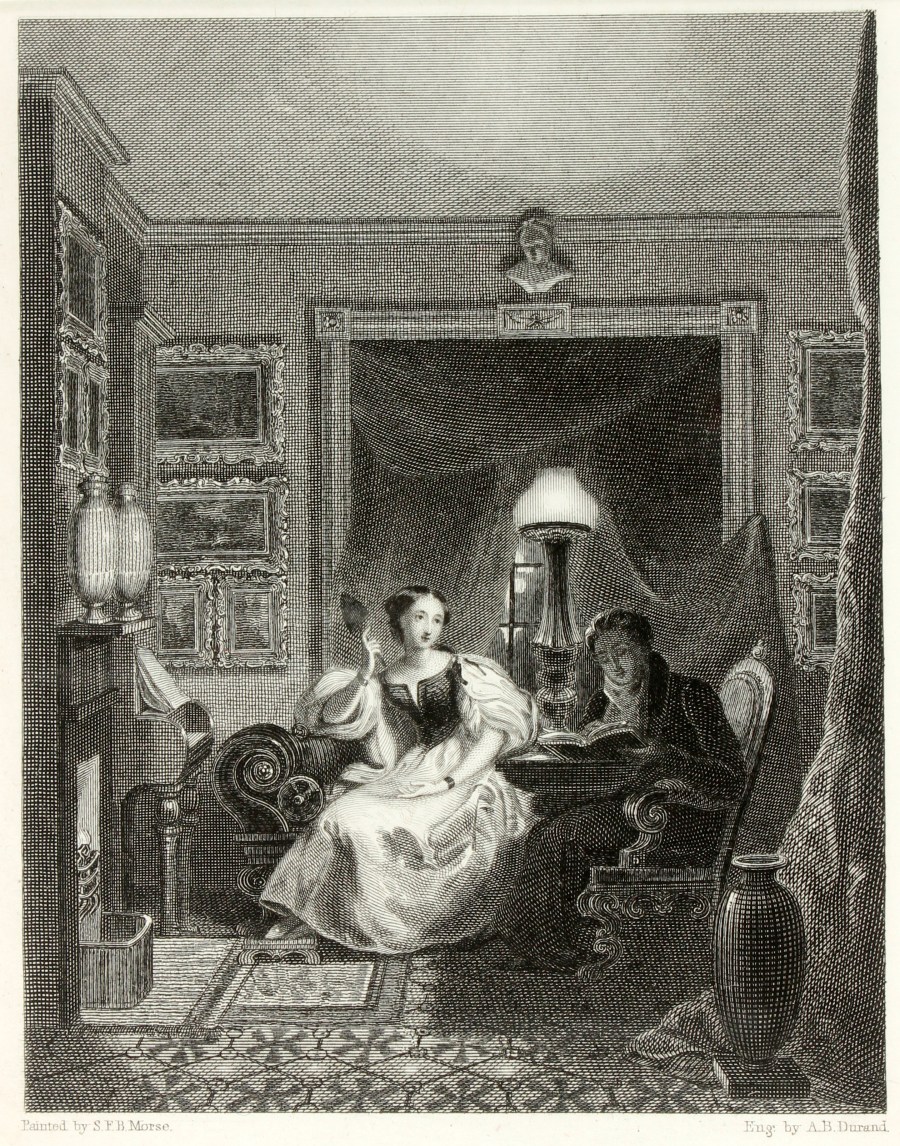
The Wife, After a painting by Samuel F. B. Morse (1791-1872), American, engraved by Asher B. Durand (1796-1886), American and published in The Atlantic Souvenir, 1830.
Samuel F. B. Morse, son of a prominent minister, attended Philips Academy in Andover, Massachusetts and, from there, moved onto Yale to study philosophy, mathematics and equine science. He was truly brilliant. After graduating Phi Beta Kappa in 1810, however, Morse rejected the thrust of his education to pursue the life of a painter. Studying in Europe for three years, Morse gained enough experience to receive portrait and historical subject commissions upon his return. His life as an artist, though, was not without challenge. A precipitous drop in sales during the panic of 1819 almost sunk his chosen profession. The death of his first wife, in 1825, disheartened him even more. Persistence, and no small amount of talent, fortunately, brought him back to professional health. By 1830, when the engraving of The Wife appeared in The Atlantic Souvenir, Americans would recognize Morse as an artist of distinction.
Asher B. Durand, five years younger than Morse, came from no such privilege. The eighth of eleven children born to a watchmaker’s family in Maplewood, New Jersey, Durand apprenticed to an engraver in 1812 at the age of sixteen. The young man showed such skill and promise, he became a partner within ten years. In 1823, the painter John Trumbull, hoping to capitalize on America’s growing pride as a nation, selected Durand to engrave his masterpiece, The Declaration of Independence of the United States of America, July 4th, 1776. The resulting print earned Trumbull considerable praise – a copy hangs in the White House today – while Asher B. Durand received welcome attention from painters desiring the services of a gifted engraver. By 1830, when The Wife appeared in The Atlantic Souvenir, Durand’s reputation as one of America’s most skilled engravers was secure.
And here is where our consideration of this little print informs our understanding of the path of life. In 1830, Asher B. Durand began to pursue a desire to devote more time to painting his own vision of the world, rather than engraving the paintings of others. Concurrently, Samuel F. B. Morse, who never could forgive himself for being away from home on business when his wife Lucretia died, left for Europe in the hope an extended sojourn would provide some inner healing.
On his 1832 return voyage to America, Morse witnessed the electromagnetic experiments of a fellow traveler, Charles Jackson, of Boston, and had an idea. While resuming his professional practice as a painter, Morse began to experiment with a single wire telegraph capable of sending a series of dot and dash communications. Commercial interest in his electromagnetic device consumed more and more of Morse’s time and within a few years, the telegraph, and the code that bears his name, began to connect the world. This is how we best remember Samuel F. B. Morse.
Asher B. Durand, the successful engraver, continued to paint as part of his wide artistic practice. Within a decade, Durand’s paintings of the American landscape attracted the attention of the artistic community, particularly the painter Thomas Cole. Together they become the nexus for America’s first native artistic movement: the Hudson River School. This is how we best remember Asher B. Durand.
In 2005, Durand’s 1849 painting Kindred Spirits, depicting Cole and the poet William Cullen Bryant, sold at Sothebys for a purported $35,000,000.
So, what does this teach us about the goals we set and the aspirations we hold so dear? Work hard, challenge your mind, and be open to a future yet unknown.

 The Unintended Curator